


To get rid of parasites, you must first understand which parasites have settled inside the patient and whether they exist.A simple finger prick blood test is available for this.If the eosinophils do not exceed 5, you can be sure that there are no parasites in the body.If this indicator is above 5, a stool examination for worm eggs is performed and, based on the results of the analysis, treatment will be prescribed.Anti-parasite medicines have many unpleasant side effects: hair loss, seizures, kidney failure, drug-induced hepatitis and even liver cirrhosis, so only a doctor should prescribe them.
The most common symptoms usually attributed to the presence of parasites include nausea, fatigue, lethargy, paleness, irregular bowel movements and constipation.These symptoms are more likely to indicate anemia or a thyroid disorder.If they appear or have been appearing for some time, the most sensible thing to do is to consult a doctor.And as a preventative measure, wash your hands more often.
Fear of parasites
Many people are sincerely and very afraid of parasites, which supposedly strive to appear in their body.And therefore, they are ready to shell out a lot of money to scammers who not only look for, but also “find” parasites, and then “prescribe” to naive victims all kinds of food supplements and other remedies for imaginary helminths.Some try to remove parasites on their own using garlic, onion and horseradish - the drugs made from them are at least safe.But what will be in the jar received by aspiring doctors is not yet known.
The problem of parasitosis really exists, it only exists in the countries of Asia, Africa and South America.Therefore, in some Asian countries, human infection with opisthorchiasis reaches 80%.There they take special measures to disinfect water and food.But all this is not our case;tropical parasites do not survive in our climate, although opisthorchiasis is common in cold regions.It is transmitted through fish, as well as through dogs and cats that feed on this fish.But today we will talk about other parasites that can be infected in our central area.These parasites are roundworms and pinworms.
Nematodes and ascariasis
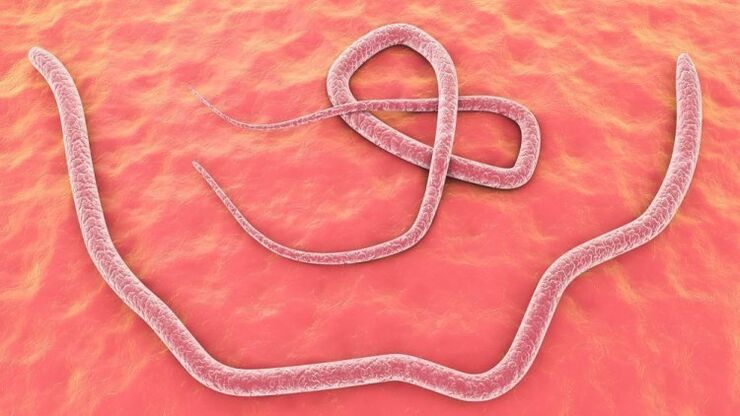
Roundworms only parasitize humans.The parasite is a rather long round worm, reddish-yellow in color.The length of an adult male is 15-25 cm, the female is longer - up to 20-40 cm.If roundworms penetrate the human body, the disease ascariasis develops.In this case, the gastrointestinal tract is most affected, but other organs may also be affected, as well as allergic reactions.Ascariasis is quite widespread and affects 60-85 people out of 100 thousand.
Nematode life cycle: through the blood to the intestine
A sick person does not pose a danger in terms of infection, since infection occurs when eggs enter the body.And the eggs come out in the feces and mature first in the soil.The eggs have a dense shell, so they can remain in the ground for up to seven years.You can get the infection by eating vegetables, fruits, or berries that have been exposed to roundworm eggs.The parasite goes through a long cycle of movement in the body.First, the larvae hatch from ingested eggs and enter the blood through the intestinal walls.With the blood flow they migrate to the liver, the heart, then to the lungs and from these to the pharynx.When the patient ingests them, the larvae in the intestine mature into adult worms capable of laying eggs.
Symptoms: abdominal pain, nausea, weight loss

As the larvae travel through the body, allergic manifestations come to the fore.Mechanical damage to the organs through which the larvae pass is also possible: liver, blood vessels, lungs and intestines.The patient may develop high fever, rash and pain in the liver area and, at the end of the migration phase, cough and shortness of breath.When roundworms settle in the intestine, poisoning with their waste products occurs.Additionally, the sharp ends of the worms can injure or even puncture the intestine.Manifestations include abdominal pain, morning sickness, loss of appetite, and stool changes.In addition, health complaints, inadequate sleep, headaches, increased fatigue and weight loss occur.The presence of roundworms in the intestine causes a deficiency of vitamins B6, A and C.
Diagnosis of ascariasis
For diagnosis, blood is taken for a general analysis (increased eosinophils, increased ESR, sometimes anemia) and an antibody test.Under the microscope, larvae can be detected in the sputum of patients.In the intestinal stage, roundworm eggs and sometimes the worms themselves are detected in the feces.
Medicines for ascariasis
Treatment for ascariasis does not require hospitalization, except in complicated cases.Patients are prescribed a diet rich in vitamins, low in fats and carbohydrates.Eat four or five times a day.Medicines with antiparasitic effect, antihistamines, probiotics and enzymatic preparations are indicated.
Complications of ascariasis

A complication of ascariasis can be intestinal obstruction due to blockage caused by a ball of worms.When roundworms crawl into the bile ducts, vomiting, jaundice and severe pain in the abdomen on the right occur.By the same principle, ascariasis pancreatitis and respiratory failure are possible when the airways are blocked by parasites.
Pinworms and enterobiasis
Pinworms are translucent white worms only 0.5-1 cm long.One end of their body is pointed, which explains the name.They are parasites primarily in the large intestine and can disappear over time without medication if autoinfection does not occur.The fact is that to lay eggs, females descend into the anus and do it in the perianal folds, after which they die.For the patient, this process causes severe itching.If, after scratching an itchy area, the patient does not wash his hands, the eggs will end up on linens, surrounding objects, in food and may remain under the nails.The patient can swallow pinworm eggs himself.This is how self-infection happens.
Symptoms: anal itching

The main symptom is severe itching in the anus at night, since it is at this time that the parasite lays eggs.With enterobiasis, symptoms from the gastrointestinal tract are possible: abdominal pain, nausea, increased gas formation, and from the nervous system: fatigue, sleep disturbance or insomnia (severe anal itching interferes with normal sleep).Pinworms can crawl into the female genital tract, causing irritation, pain and discharge.And they also cause coughing if they enter the lower respiratory tract.
Diagnosis and treatment of enterobiasis
Basically, scraping of the perianal folds (or application of tape) is used, after which the resulting material is examined under a microscope.This way you can detect helminth eggs.In a blood test, as in the case of ascariasis, you will notice an increase in eosinophils;if complications develop, signs of inflammation will appear (increased leukocytes, increased ESR).Antiparasitic drugs are used for treatment.Some of them are contraindicated for pregnant and breastfeeding women.To reduce itching, the anal area is lubricated with an anesthetic ointment.The most popular folk remedy is garlic.
Complications: dysbacteriosis, appendicitis
Complications will depend on the body's reaction and the number of parasitic worms.Dysbacteriosis, appendicitis, vaginitis, salpingitis, endometritis (inflammation of the appendages) are possible.
Prevention of ascariasis and enterobiasis

Ascariasis:
- identify and treat patients in a timely manner;
- loosen the sandboxes (eggs do not tolerate direct sunlight);
- wash your hands after using the bathroom and before eating;
- wash vegetables, fruits, berries.
Enterobiasis:
- iron the linen carefully, especially the creases;
- clean the apartment with disinfectants;
- provide the patient with personal bedding and a place to sleep;
- It is important for children to cut their nails short.